FAQ and practical guide

What is balcony solar?

Balcony solar is a compact solar setup designed for apartments, condos, patios, and small homes. The new U.S. conversation is about whether small listed systems can safely plug into a household circuit under clear state, utility, and product rules.

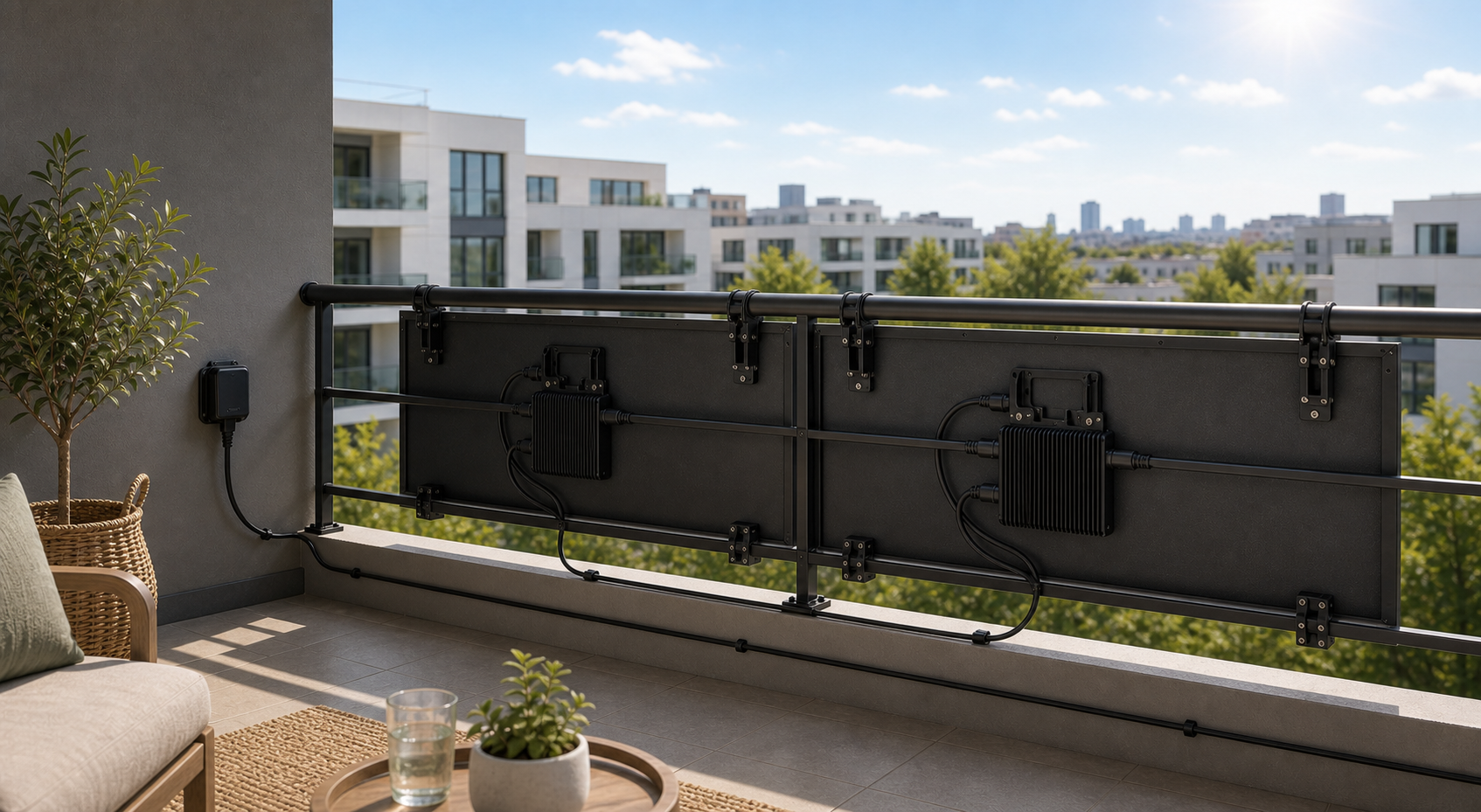
Back side of two balcony solar panels mounted flat and vertically between the top and lower balcony railing.
Flat railing mount: panels sit vertically against the balcony rail instead of tilting outward.

This guide explains common practices and regulatory trends. It is not legal, electrical, or utility advice. Always confirm the rules for your address before installing grid-connected equipment.

The basics

How a balcony solar kit usually works

A small panel or pair of panels mounts to a balcony rail, patio stand, wall bracket, or similar structure. The panels feed a microinverter or battery system. In an approved plug-in setup, the system offsets some of the power your home is using instead of sending all energy through a traditional rooftop-solar interconnection path.

The important phrase is approved plug-in setup. A normal rooftop array is engineered, permitted, interconnected, and usually hardwired. Balcony solar is trying to create a lighter path for smaller systems without skipping safety, anti-islanding, metering, and code requirements.

Typical kit parts

  • One or two compact solar panels
  • Listed inverter or battery-integrated inverter
  • Mounting hardware rated for wind and rail type
  • Outdoor-rated cables and connectors
  • Monitoring meter or app
  • Utility instructions or export-control settings

Origin story

Where balcony solar came from

Balcony solar is not a new kind of solar cell. It is a newer product and policy category that combines mature photovoltaic panels, small inverters, simple mounts, monitoring, and a legal path for people who do not control a roof. Its modern form grew fastest in Germany, where it became known as a Balkonkraftwerk or plug-in solar device.

1950s-2000s

Solar gets small enough to modularize

Practical silicon solar cells were demonstrated in the 1950s, then improved through space, off-grid, and rooftop markets. As panel prices fell and inverter electronics shrank, a one- or two-panel system became realistic for ordinary homes.

2010s

Europe turns panels into an appliance

Early plug-in PV kits appeared in Europe for renters, apartment owners, patios, garages, and balcony rails. The idea was simple: produce a small amount of daytime power close to where it is used, without a full rooftop project.

2016-2019

Germany moves it out of the gray zone

Germany's DGS PVplug working group formed around plug-in solar safety and standards work. Their campaigns helped push clearer VDE pathways for small plug-in generators, including owner-managed registration and practical limits for household-scale systems.

2020-2024

Balcony solar becomes mainstream in Germany

Energy-price pressure, lower kit costs, simpler registration, and an 800W inverter limit helped move balcony solar from hobbyist equipment to hardware sold through mainstream retail channels. The German model became the reference point for other markets.

2025-today

The U.S. starts building its own rulebook

In the United States, the category is still younger and more fragmented. As of October 28, 2026, ten states have enacted pathways, including some with future effective dates. California signed SB 868 on September 30; New York remains pending, while other proposals stalled. The rulebook is now centering on equipment listings, export control, utility notice, and renter or condo protections.
Regulations and practices

What new rules are trying to standardize

Equipment listing

Inverters, cables, batteries, and outdoor components need clear safety ratings. A listed inverter does not automatically make a complete kit listed: some state pathways require the panels, cables and inverter to be evaluated together. Bright Saver's kit documentation explains why its UL 3700-certified inverter subassembly is not yet whole-system certification.

Utility notification

Utilities need to know whether a system can export power, how it shuts down during outages, and whether it affects meters or line workers.

Size and export limits

Emerging rules often focus on small wattage caps, export-limited operation, dedicated outlets, or simplified forms to keep the category manageable.

Building permission

Even if a state allows a plug-in path, renters and condo owners still need to respect lease, HOA, facade, fire-access, and wind-load rules.

California SB 868

Signed into law. A pathway for qualifying systems, not every solar kit.

Governor Newsom signed SB 868 on September 30, 2026, as Chapter 985. The new pathway takes effect January 1, 2027. It covers receptacle-connected devices that offset electricity used on site.

Count total AC output

The limit is 1,200W aggregate AC per dwelling, not the panels' DC rating or a separate allowance for each inverter. Two 900W inverters at full output exceed it. A limit alone does not establish eligibility.

Ask for the system listing

The device must be certified as a plug-in photovoltaic system by UL or an equivalent nationally recognized testing laboratory (NRTL), meet the applicable electrical codes, and have certified outage isolation. A CE mark, an inverter-only certificate or a seller's "compliant" claim is not enough evidence.

Notice is not prior approval

Qualifying systems are exempt from traditional utility interconnection requirements and agreements. Utilities cannot demand prior approval, a fee or extra controls beyond the integrated device, but may require simple online registration with address, make, model and size.

Installation still matters

Check circuit suitability, local building and fire rules, safe mounts and property permissions. The exemption is scheduled to repeal January 1, 2030; a separate certification requirement for receptacle-connected devices sold starts then. Anti-islanding stops grid-connected generation during outages; it is not backup power.

Sources: Governor's signing announcement, SB 868 chaptered text (text mirror). Checked October 28, 2026. This guide is not legal advice or installation approval.

Buying across all 50 states

Choose the electrical pathway before the shopping list.

Grid-connected balcony system

Check your state's effective law, output cap, listing scope and notice process. California's 1,200W rule does not transfer elsewhere: Maine requires an electrician and a dedicated circuit above 420W AC. No dedicated state law is not an automatic ban, but the normal interconnection and permitting process may apply.

Find your state in the 50-state tracker.

Portable panel and battery

Panels feeding an Anker C1000 Gen 2 or EcoFlow DELTA 3 Plus can power appliances from the station's own outlets without injecting into building wiring. This is a different use case, not an SB 868 plug-in generator. Never connect its AC output to a wall outlet. Placement, fire rules and property permission still matter.

Match the exact components

Request the approved panel, inverter, AC cord and protection combination. Check panel Vmp, cold-weather Voc, input current, connectors and mounting loads. Do not mix look-alike DC connectors or use AC extension cords or power strips outside the listed system's instructions.

Measure before sizing

Kasa KP125M and P3 Kill A Watt measure indoor appliance loads, not solar feed-in. Emporia Vue 3 measures home energy with qualified electrical-panel installation; it does not replace a manufacturer's export controller. Size generation around sunny-hour usage rather than an advertised payback time.

Safety context: UL Solutions on plug-in PV circuit and outlet risks. Equipment certification and electrical-code acceptance are separate questions. See the component recommendations for U.S. models and availability notes.

Tradeoffs

Pros and cons of balcony solar

Consumer benefits

  • Lower entry cost than rooftop solar.
  • More accessible to renters, condo owners, and small homes.
  • Portable or removable hardware when designed well.
  • Simple production visibility through meters and apps.
  • Useful education path into solar without a whole-house project.

Real limitations

  • Limited production because balcony space is small.
  • Shade, orientation, and railing angle can crush output.
  • Rules vary by state, utility, city, landlord, and HOA.
  • Cheap or non-listed hardware can create safety and insurance risk.
  • Battery add-ons improve timing but raise cost and complexity.

Savings math

What can it save?

A conservative planning range for a 400W balcony kit is roughly 25-50 kWh per month when it gets decent sun and most power is used in the home. At $0.15-$0.35 per kWh, that is about $4-$18 per month. An 800W setup can roughly double that if the balcony has the space, sun, and legal pathway.

Savings depend on sun hours, panel angle, shade, inverter efficiency, electricity rate, and whether exported power is credited. If you are away during sunny hours, a battery or export-credit program may matter more than the panel wattage.

Setup Useful energy Monthly value at $0.22/kWh Best fit
200W starter panel 12-25 kWh $3-$6 Testing sun and rules before buying bigger.
400W rail kit 25-50 kWh $6-$11 Apartment balconies with strong daytime sun.
800W kit 50-100 kWh $11-$22 Larger patios or rails with approved export controls.

Market tension

Industry concerns vs. consumer benefits

Utilities and electricians worry about

Backfeed, outage shutoff, meter behavior, circuit overload, nuisance exports, non-listed imports, unclear responsibility, and owners installing equipment without understanding the circuit.

Consumers want

A legal way to participate in solar without owning a roof, taking on a large loan, or waiting months for a traditional project.

Manufacturers need to prove

Products are listed, instructions are realistic, export behavior is clear, mounts are safe, and support does not disappear after the sale.

Good regulation should create

Smaller approved categories, clear wattage limits, simple utility notification, equipment rules, and enforcement against unsafe plug-and-play claims.

FAQ

Common balcony solar questions

Can I just plug a solar panel into any outlet?

No. Treat that claim with caution. A legal plug-in pathway depends on listed equipment, state rules, utility procedures, circuit suitability, and sometimes a dedicated outlet or export limit.

Is balcony solar the same as rooftop solar?

No. Rooftop systems are larger, fixed, and usually hardwired through a formal permitting and interconnection process. Balcony systems are smaller and may be removable, but still need a safe electrical path.

Will it power my whole apartment?

Usually not. Balcony solar is best for offsetting a slice of daily use, not replacing the grid. Think router, refrigerator contribution, laptop loads, fans, small appliances, or battery charging.

Do I need a battery?

Not always. A battery helps if you use most electricity after sunset or if export credits are poor. It also raises cost, weight, safety considerations, and product-review complexity.

What should I check before buying?

Check state status, utility rules, local code, lease or HOA restrictions, panel mounting safety, shade, outlet/circuit requirements, product listings, warranty, return policy, and documentation.

Research links

Good starting points